Deconstructing Leadership Styles in the Workplace

[this blog post is under construction...]
Being on the receiving end of less than inspiring management practices sucks! There is no two ways about it. Secondhand accounts of horror stories from peers about a "horrible boss" stirring conditions of team dysfunction are commonplace in social circles. Adding my own stories to the wall of "pain" compelled me to research how management styles impact productivity in the workplace. In addition, through the process of writing on the topic, I make efforts to disclose styles that resonate most discerning that which resonates positively and less so.
Lets summarize strengths and limitations of each style moreover building understanding for how emotional intelligence (EI) (and the underlying capabilities and competencies) shape and transform team culture. In some cases the "juice may not be worth the squeeze". That may be true. Fun fact: empirical findings demonstrate that organizational climate accounts for upwards of 1/3 of company performance.
As a secondary goal of mine is for readers to feel invited to use the space as a blank canvas created in mind to reflect on lived experiences or a slice of memory whereby a relationship thrived or fell apart as a consequence of leadership style and fit or lack thereof. Broadly speaking, and to steer clear of black-white thinking, the working definition of leadership is defined as the context in which one is responsible for another person and the expected expression of one or more leadership styles expressed.
Leadership Styles
Below are the six distinct leadership styles derived from research conducted by Daniel Goleman et al, as sampled from thousands of business executives and senior leadership. Perhaps you've heard these exact words articulated by manager, friend/family, or from yourself at one time or another.

According to the author of "Leadership Gets Results" no one style can be relied on to consistently drive positive performance. Harnessing different components of emotional intelligence (EQ) is necessary to wield four or more styles and the flexibility to put each into action is how the largest gains in performance are unlocked.
To preface styles are not like Disney's "Sword and the Stone" movie although I can relate to that comparison. Side step black and white thinking (or self-limiting beliefs) with knowing that styles are learned through deliberate practice. This is true even if the initial feeling is unnatural or inauthentic sometimes referred to as imposter syndrome.
Strengths & Limitations
At first read the coaching, democratic, and affiliative styles resonated most for how I prefer to manage others and have practiced in the past with moderate success. Moderate success is great, but what is the point of learning anew if not to be humbled by what one does not yet know.
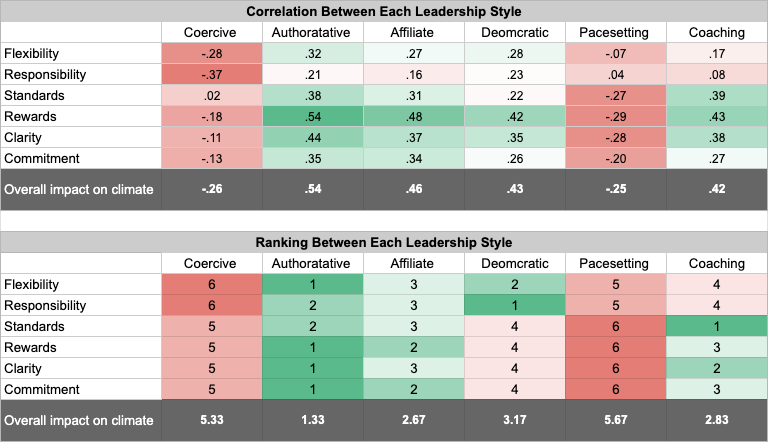
The aforementioned styles are reportedly strong inputs for driving performance (see correlational matrix below), however each style is not without its limitation. It stands to reason that my modus operendi clusters into a bottom-up management approach whereby goals, projects, and tasks are informed largely by employee feedback.
Coaching Style:
- Emphasis on coaching vs. punitive measures or external rewarding
- Personal development over work related tasks
- Suggesting constructive feedback that addresses the "what" and "how"
- Help employees identify unique strengths and areas for improvement
- Focus on personal goals and aspirations
- Employee retention↑
- Address/confront actions and not the self
- Establishing agreements (e.g. development plans, role & responsibility)
- Excel at delegation: take 'lumps' in short term quality and productivity for unrealized gain in the future
- Not helpful if employees are resistant to learning
- Less helpful if employees have more expertise
- Powerful tool; used least often in high pressure economy
- Most managers inept at coaching or unfamiliar with ongoing performance feedback
- Dovetails with authoritative style
Democratic Style:
- Stakeholders reach decisions collectively
- Reaching consensus through listening
- Dynamic relationship with conversation/exchange between parties
- Helpful when manager is without a vision
- Associated with trust building, respect, commitment, fierce loyalty, and responsible ownership
- Relies on competent persons informed on the topic at hand
- Lowest impact on climate
- May precipitate confusion and/or escalate conflict through endless meetings, elusive consensus, waiting for a blinding insight
Affiliative Style:
- "natural relationship building"
- Manage by building strong emotional bonds (reap benefit of fierce loyalty)
- Associated with habitual innovation, shared ideas & inspiration, and risk tasking
- Ample positive feedback driving motivation↑
- Tends to own emotions openly
- Moral building when trust is broken/rebuilding ties
- Positive feedback > constructive feedback
- Exclusive reliance may incentivize poor performance to go unnoticed (mediocrity tolerated)
- Pairs well with authoritative style
Pacesetting Style:
- Expect excellence and self-direction
- Obsesses about better and faster!
- Expectations poor communicated leading to second guessing what leaders want
- Overly task focused; may limit creativity and discovery
- Will step in and do the work for others
- Not trusting subordinates (micromanagement)
- Works well with: self-motivated, highly competent team members
- Never use pacesetting by itself
Authoritative Style:
- Mobilize people toward a vision
- Motivates people by making it clear how their work fits into a larger vision for the organization
- Maximize commitment to the organization's goals and strategy
- Standards for success are clear to all, including rewards
- Freedom to innovate, experiment, and take calculated risks
- States the end but gives people plenty of leeway to devise their own means
- Style works well in almost any business situation, most effective when business is adrift
- Approach fails when working with experts or peers with more experience
- Authoritative becomes over-bearing can undermine egalitarian spirit of an effective team
Coercive Style:
- Least effective in most situations
- Extreme top-down decision making kills ideas on the vine
- Sense of responsibility evaporates: lose sense of ownership and accountability, unable to act on their own initiative
- People adopt an attitude of resentment, actively working against and not with the leader
- Insensitivity to the morales and feelings of others
- Damaging effects on reward system (erodes pride in job satisfaction)
- Diminished clarity and commitment
- Use style with extreme caution and when absolutely imperative (e.g. company turn around, hostile takeover, or genuine emergency)
The Impact of Leadership Styles on Drivers of Climate
My initial impression from this table are as follows. With but few exceptions both coercive and pacesetting styles rarely drive positive performance. Simple math counts 10 out of 12 aspects compromised when either leadership style is used. Even the most effective styles for a given aspect of culture account for less than 50% of the relationship. The latter implies stated need for flexible or context specific adaptations across styles as well as considerations for the actions of direct reports and blending of complementary styles across management teams impacts performance.
Note that the overall impact is not an equal weighted average across each aspect of climate. The weightings from the research were not reported in the primary reference article.
The the second table is transformation of correlation to rankings across aspects of culture. As per the report, the ranking matrix made it more apparent that democratic style isn't as effective as I would have thought it to be.
The Machine that Maketh the Manager
"Shipping to a store near you": The factory that manufactures mangers is of course fictional, and yet we make attribution errors in an attempt to understand or define others as fitting a mold, or being cut from the same cloth. Every (human) manager has a story. It's our choice to invest the time to get to know it or not. Whether they choose to share or not is predicated on the relationship and expectation setting.
The personal narrative and disclosures is the factory from which the styles are learnt. From socio-cultural influences to individual belief systems and health, basic leadership styles can't exist in a vacuum. Make note of patterns from interactions with a manager of interest in order to cultivate an understanding and perhaps humility for a "horrible" boss before applying labels.

Hit Points: Self-Esteem & Sense of Well-Being
If you have ever encountered a manager whose behaviour or approach flattened you like a "Mac Truck" or stated differently, left fragmented and seemingly disparate parts [of the self] to put together again, you know how vitally important healthy working relationships are to building up if not preserving self.
Self-esteem and subjective well-being are dynamic in nature involving a confluence of inputs tilting the scale in either direction. Being knocked against the ropes worse yet KO-d in the ring of workplace politics, the worst possible outcome of "horrible boss" or poor management is individuals blind-sided by said Mac Trucks of challenging personalities and in the process not picking up pieces fast enough to be resilient and grounded. Knowing that self-esteem (what I call critical hit points or HP) is on the line, may help all parties to acknowledging the "bigger picture" and hopefully choosing a more compassionate approach of relating.
Top-Down vs. Bottom-Up Approach To Management
Expecting the Best and Getting It Through a Decidedly Good Fit
Sources:
Leadership that Gets Results https://med.stanford.edu/content/dam/sm/CME/documents/Goleman-20--20Leadership-20That-20Gets-20Results-20093019-20-1-.pdf